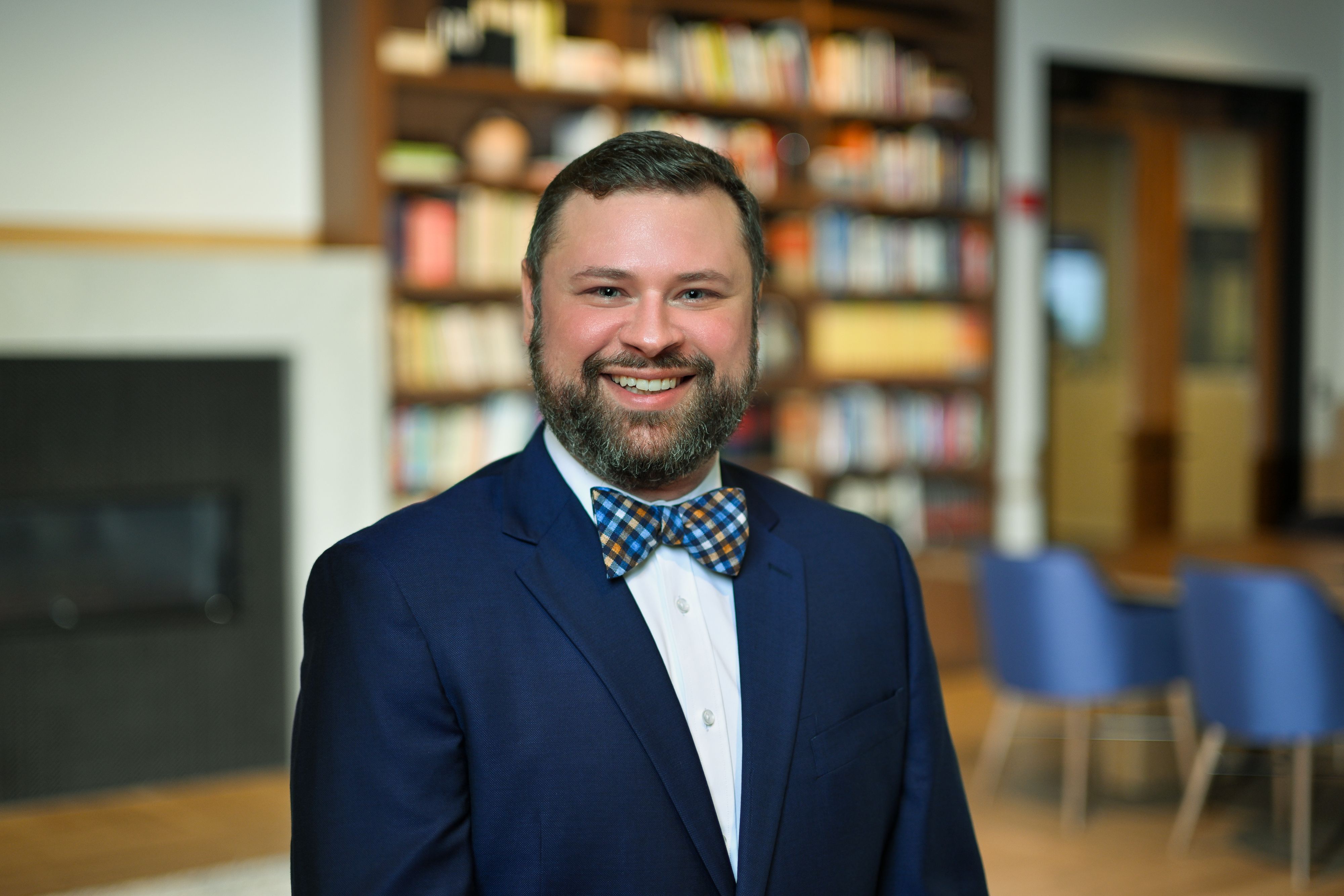
Ethan Hussong smiling in a library, wearing a navy suit and patterned bow tie.

Ethan Hussong

I build durable institutions by making complex technology easier to understand, govern, and improve.

I’m Sr. Manager, IT Engineering at FHLBank Chicago, where I also hold the officer designation of Vice President. I connect technical reality to business impact by making risk and ownership visible. I help teams become more capable without depending on heroics.

Location
Chicago, IL
Past nonprofit service
Treasurer, 7th Regiment Youth Performing Arts OrganizationMar–Dec 2025Served with responsibility for nonprofit governance and financial stewardship, including budget and executive-committee work.
Volunteer IT Support, Phantom Regiment2015–2017Provided volunteer technology support for a touring drum and bugle corps.

Field Guide

People

I want people to know what matters, speak plainly, and have room to grow.

When I manage, I make effective work easier without relaxing the standards. People deserve to know why the work matters, what good looks like, and where they have room to decide. Feedback should arrive soon enough to act on, before issues pile up.

Psychological safety is central to how I lead. People should be able to bring ideas, point out risks, or admit uncertainty. “Bring solutions, not problems” shuts down exactly the conversation a manager needs to hear. Bring the problem. Bring your read if you have one. We can work on the answer together. Safety doesn’t mean avoiding hard feedback. Someone should be able to challenge a plan, hear hard feedback, and remain part of the team.

Some decisions will disappoint people. I can live with that. My responsibility is to listen and explain how the decision follows a standard that applies to everyone. I don’t need to be liked in every decision. I do need to treat people with dignity and help them grow. Over time, the team should become less dependent on any one person, including me.

Read the field note

Reliable Systems

I pay attention to what happens when a system fails and the usual expert is unavailable.

I start with the architecture, then look at the questions around it. Who owns the service? How do we stop a bad change? When did we last practice recovery? If those answers live in one person’s memory, the service is fragile no matter how sound the design is.

When I need more speed, I look for structure before I ask for more effort. Clear decision rights keep routine work moving. Smaller changes make it easier to see what happened. A practiced recovery path gives the team options when a change goes wrong. I pay attention when work feels fast only because the same expert is always available.

During an incident, I want calm authority and useful evidence. Restore service first. Study the conditions that produced the failure afterward. Good preparation means people can recover without waiting for one expert or hiding what they don’t know. The incident may still be hard, but the team knows how to work through it.

Read the field note

Stewardship

A choice is easier to govern when people can see what it protects and what it postpones.

When I say stewardship, I mean leaving an institution more capable than I found it. Resources are finite, and attention is one of them. Every commitment closes off some other option.

So I work to make the choice visible. What are we protecting? What are we postponing? Who carries the consequence? What evidence would change our minds? A budget or risk discussion becomes more useful when people can see the assumptions. Naming risk isn’t pessimism. It preserves options while there is still time to use them.

Serving as a nonprofit treasurer made the fiduciary side of this concrete. Commitments have to fit the resources and controls available in practice, not just on paper. I bring the same habit to technology leadership, where a reasonable decision today can quietly become someone else’s obligation tomorrow.

Process should match the stakes. I don’t want another layer of review unless it helps the right person see the trade-off, make the call, or revisit it when the facts change.

Read the field note

Learning

I read and write to test whether an idea changes the work.

I read to improve the questions I bring to work. An idea earns its place when it changes a practice. It might sharpen an operating review or help a one-on-one reach the subject everyone has been avoiding. Sometimes it gives me language for an assumption that has been hiding inside a decision. I return most often to management, organizational behavior, and systems thinking.

Writing is how I test what I think I understand. If I can’t state an assumption plainly, I have more thinking to do. Putting the reasoning on a page also gives someone else a fair chance to challenge it.

I match the form to the question. Some things resolve in a five-minute conversation and would only get muddier in a long document. Other decisions need a record people can return to. The goal is the same: give the next person enough context to start from a stronger place.

Read the field note

Service & Community

Service reminds me that leadership carries obligations beyond a job title.

I value service that asks me to keep showing up. In 2025 I served as Treasurer of the 7th Regiment Youth Performing Arts Organization, with responsibility for governance, finance, budget, and executive-committee work. That fiduciary role ended in December 2025. Beginning in 2026, I’m making a two-year commitment to the Teach For America Greater Chicago–Northwest Indiana Leadership Circle in support of education equity. From 2015 to 2017, I volunteered in IT support for Phantom Regiment, a touring drum and bugle corps.

I try to be precise about each commitment because titles carry specific authority and obligation. Service changes what I notice, too. Mission, limited resources, and community trust have to coexist in the same decision.

My operating experience can be useful in these settings, but I don’t assume a civic or nonprofit organization should run like a company. I want to understand what the community needs and respect the institution’s purpose. Then I can contribute the discipline the role actually calls for.

A Wider Life

Work matters to me, but it isn’t my whole life.

I like pursuits that reward patient adjustment. A home lab lets me understand systems by building and breaking them without risking production. Amateur radio makes invisible infrastructure tangible. Equipment and propagation matter, but so does the courtesy of sharing a channel. Trumpet asks for individual precision in service of an ensemble, a lesson drum corps taught me long before any job did.

Other interests give me a different kind of feedback. Sim racing makes a small improvement measurable in tenths of a second. Poker and euchre turn incomplete information into something social. In a long board game, an early decision quietly changes what is possible hours later. I still write by hand with fountain pens, a daily craft that rewards patience.

I don’t want to turn every hobby into a lesson for work. Part of their value is that they are wider than work. They give my attention a different pace and let me be a beginner again. I return to professional problems with more patience, but that isn’t why I keep them.

Experience & Impact

I joined FHLBank Chicago in January 2019 to manage the operations team I’d supported as an Insight Global contractor. Since then, I’ve led systems operations and IT engineering inside a regulated financial institution.

  • Reduced change-related breakages from 123 to 9, with zero failed ITSM changes in 2024.
  • Delivered automation estimated to save $2M and 5,000 hours per year.
  • Oversaw disaster-recovery efforts spanning 125+ applications and AWS and Azure environments.

Governance & Stewardship

I approach governance as stewardship. Risks and trade-offs should be stated plainly. Decisions need evidence, and ownership needs to be clear enough that follow-through can be reviewed. My fiduciary experience comes from nonprofit treasurer service. My operating perspective comes from senior technology leadership in a regulated financial institution.

  • Nonprofit treasurer service with governance, finance, budget, and executive-committee responsibilities.
  • Senior technology leadership in a regulated financial institution.
  • Disaster-recovery oversight spanning 125+ applications and AWS and Azure environments.

Selected Notes

Reliability as a human system

Reliability depends on clear ownership, practiced recovery, and people who raise concerns early.

Start a conversation

If my experience overlaps with a problem you’re working through, I’d be glad to compare notes.

Reveal email addressEmail Ethan